Recorded Practice vs Live Conversation: Which Improves Spoken English Faster?
- Images
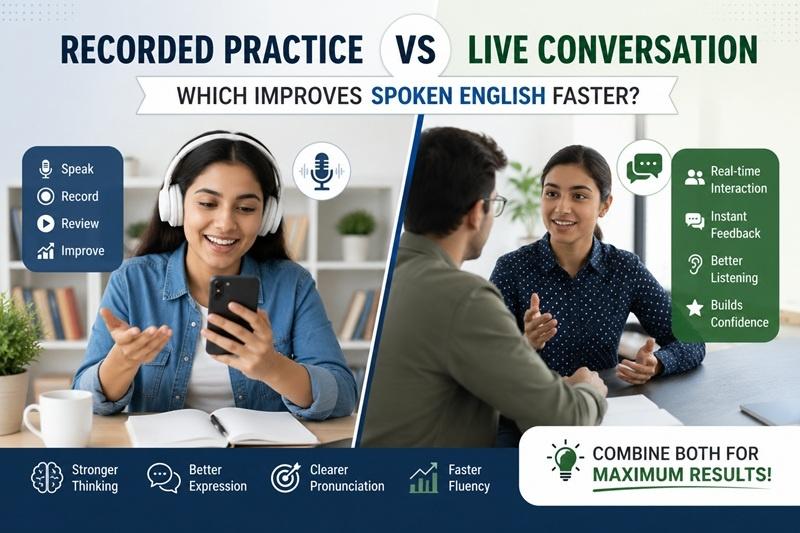
Recorded Practice vs Live Conversation: Which Improves Spoken English Faster?
Speaking English well requires more than knowing grammar and vocabulary. You need to recall words quickly, form sentences without long pauses and respond when another person says something unexpected. Two useful ways to build these abilities are recording yourself and practising with another speaker. Each develops different skills, so learners comparing online spoken English classes in Pune should understand where each method works best.
What Is Recorded Speaking Practice?
Recorded practice means speaking into your phone or computer and listening to yourself afterwards. You might describe your day, answer an interview question or speak about a topic for two minutes.
The biggest advantage is control. There is no pressure from another speaker, so you have time to notice your pronunciation, pauses and repeated words.
Recorded practice is particularly useful when you feel nervous about speaking. It provides a private space to practise before moving into real conversations.
Live conversation adds something a recording cannot: another person. You need to listen, understand and respond immediately. This is why interactive speaking practice is an important part of a good spoken English course.
What Does Recorded Practice Improve?
Recording yourself makes your speaking habits easier to notice.
Listen to an old recording and ask simple questions. Did you pause too often? Did you repeat words such as “actually” or “basically”? Were some sentences difficult to understand?
You can then record the same topic again and compare both attempts.
This method also makes progress visible. A recording from three months ago provides a useful benchmark against your current speaking ability.
Why Is Live Conversation Different?
Real conversations are unpredictable.
You do not know exactly what the other person will say. You may need to answer a question, clarify your meaning or change your response halfway through.
This pressure trains spontaneous communication.
Live practice also develops listening skills. You become familiar with different speaking speeds, pronunciation patterns and ways of expressing the same idea.
The goal is not to create perfect sentences. It is to communicate while the conversation continues.
Which Method Builds Confidence Faster?
The answer depends on what is holding you back.
If you know what you want to say but feel uncomfortable hearing your own English, recorded practice is a good starting point. It allows repetition without social pressure.
If you speak comfortably alone but freeze when someone asks an unexpected question, you need more live conversation.
Confidence in conversation comes from experiencing real interaction repeatedly, rather than waiting until your English feels perfect.
Can You Combine Both Methods?
Yes. In fact, they work well as a simple practice cycle.
Try this approach:
Choose one everyday topic.
Record yourself speaking for two minutes.
Listen once and identify one problem.
Speak about the same topic with another person.
Notice where you hesitate during the conversation.
Record yourself again later.
Do not try to correct every mistake at once. Pick one area, such as pronunciation, long pauses or sentence structure, and work on it consistently.
How Do You Know Which Practice You Need More?
Pay attention to where your English breaks down.
If you struggle to organise thoughts, use recorded practice. If you struggle to answer quickly, increase live conversations. If pronunciation is unclear, recordings help you listen more carefully. If you struggle to understand other speakers, interactive conversations provide better practice.
Your practice method should match the problem you are trying to solve.
Conclusion
Recorded practice and live conversation should not be treated as competing methods. Recording helps you notice mistakes, track improvement and practise without pressure. Live conversation develops listening, quick responses and the ability to communicate when you cannot prepare every sentence.
Learners looking for guided speaking practice can consider ELTIS (English Language Teaching Institute of Symbiosis). Its Spoken English courses progress from CEFR A1 to B2+ and include activities such as model conversations, oral assignments, presentations, group discussions and debates. ELTIS also provides online Spoken English learning options, allowing learners to combine structured language development with interactive speaking practice.