- Images
Decentralized finance has matured significantly over the past few years. What started as experimental protocols has evolved into complex financial ecosystems handling billions in on-chain value. For founders and technical teams building DeFi platforms today, understanding how incentive mechanisms shape user behavior is no longer optional.
Two of the most widely used incentive models—yield farming and liquidity mining—are often discussed as if they are the same. In practice, they solve different problems and introduce different design challenges. This guide explains those differences clearly, with a builder-focused lens, while exploring how DeFi Yield Farming Development Services fit into modern protocol design.
Why This Comparison Matters for Builders
Choosing the wrong incentive model can lead to:
Short-term liquidity with no retention
Token inflation without real usage
Security risks from rushed smart contract logic
On the other hand, a well-structured yield or liquidity system can improve capital efficiency, stabilize liquidity, and support long-term protocol growth.
Understanding these trade-offs early helps builders make informed architectural decisions during DeFi Yield Farming Development.
What Is DeFi Yield Farming?
Plain-language explanation
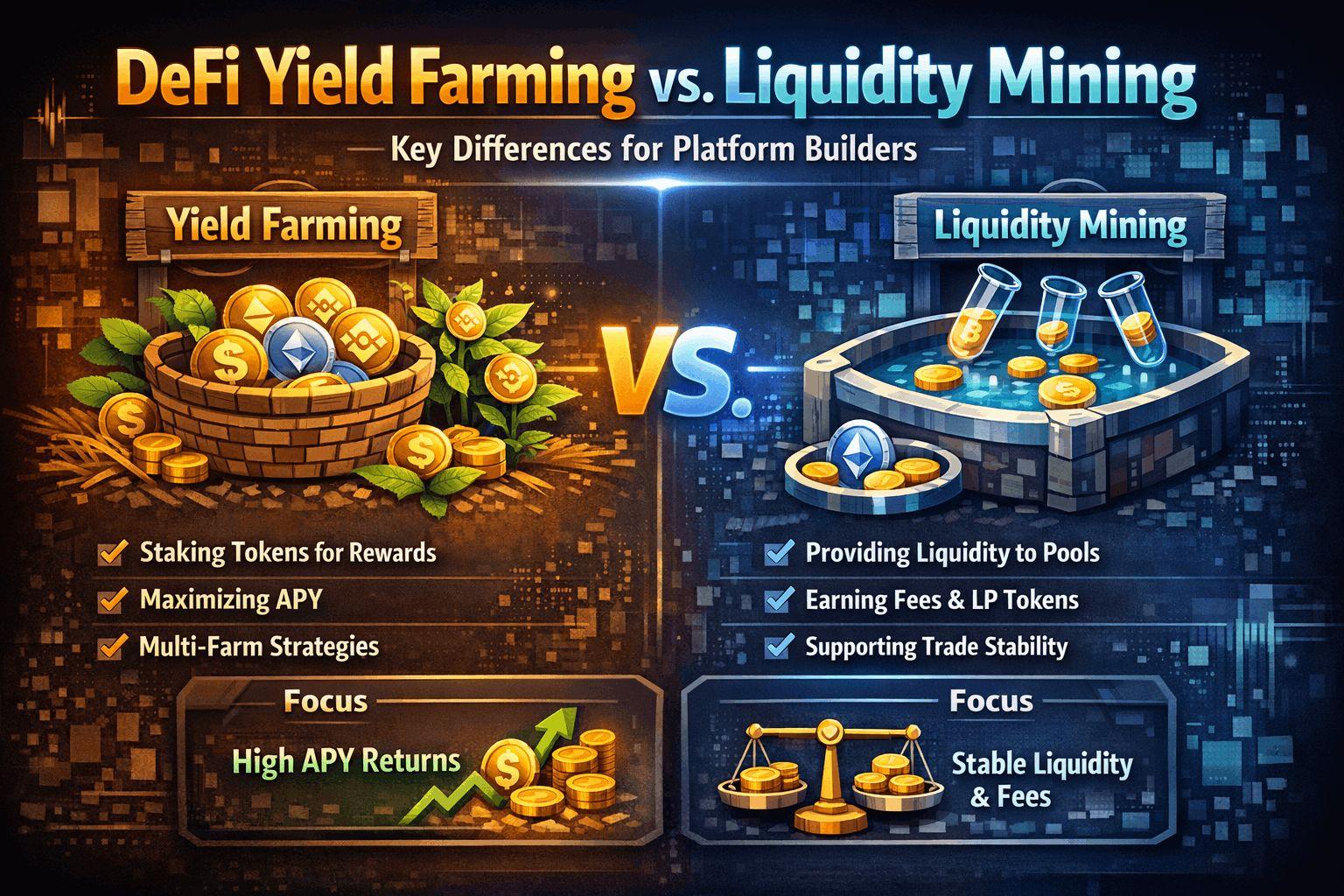
Yield farming is a strategy where users allocate crypto assets across one or more DeFi protocols to earn returns. These returns may come from interest, protocol fees, or incentive tokens.
Yield farming focuses on optimizing returns, not just supplying liquidity.
How yield farming works technically
Users typically:
Deposit tokens into a smart contract
Earn rewards based on utilization or protocol performance
Reinvest rewards into the same or other pools
Yield farming systems often interact with lending markets, automated market makers, and staking contracts built on blockchains like Ethereum.
From a development standpoint, this requires:
Accurate APY calculations
Secure reward distribution logic
Integration with multiple protocols
These complexities explain why structured DeFi Yield Farming Development Services are commonly used by teams that prioritize stability and scalability.
What Is Liquidity Mining?
Plain-language explanation
Liquidity mining rewards users specifically for providing liquidity to a protocol, usually in exchange for newly issued tokens.
The primary objective is liquidity acquisition, not yield optimization.
How liquidity mining works
Users:
Deposit token pairs into liquidity pools
Enable trading or lending activity
Receive protocol tokens as incentives
This approach was widely adopted by early DeFi platforms, including decentralized exchanges like Uniswap, to bootstrap liquidity quickly.
Yield Farming vs Liquidity Mining: Key Differences
1. Core Purpose
Yield farming aims to maximize capital efficiency
Liquidity mining aims to attract and stabilize liquidity
Builders often use liquidity mining early and introduce yield farming later as the ecosystem matures.
2. System Complexity
Yield farming platforms usually involve:
Multi-contract architectures
Auto-compounding strategies
Cross-protocol interactions
Liquidity mining systems are generally simpler, focusing on:
Emission schedules
Pool accounting
Reward claim logic
This difference directly affects development timelines and testing requirements during DeFi Yield Farming Development.
3. Risk Considerations
Yield farming risks
Smart contract vulnerabilities
Impermanent loss
Dependency on external protocols
Liquidity mining risks
Token oversupply
Short-term speculative behavior
Liquidity withdrawal after incentives end
Well-designed DeFi Yield Farming Development Services address these risks through audits, modular design, and conservative tokenomics.
4. User Behavior Patterns
Yield farmers tend to:
Move capital frequently
Compare APYs across platforms
Use automation tools
Liquidity miners are more likely to:
Stay platform-specific
Participate in governance
Engage during early growth phases
Understanding these behaviors helps builders design better interfaces and incentive structures.
Which Model Makes Sense for Your Platform?
There is no universal answer. The choice depends on your platform’s lifecycle and goals.
Yield farming is often better suited for:
Protocols aiming for long-term engagement
Platforms with advanced financial logic
Products focused on capital efficiency
These projects typically require deeper expertise in DeFi Yield Farming Development Services to ensure security and sustainability.
Liquidity mining is commonly used for:
Early-stage launches
Rapid liquidity onboarding
Token distribution strategies
Many successful protocols combine both approaches rather than choosing one exclusively.
A Common Hybrid Approach
A pattern observed across the DeFi ecosystem:
Launch with liquidity mining to attract early users
Introduce yield farming for retention and efficiency
Gradually reduce emissions as organic usage grows
This approach balances growth with long-term protocol health.
Practical Development Insights Builders Should Know
Security is foundational
Industry reports consistently show that smart contract flaws remain the leading cause of DeFi losses. Independent audits and formal verification are essential—not optional.
Tokenomics matter more than APY
Sustainable reward structures outperform aggressive yields over time. Short-term incentives without utility often lead to value erosion.
UX impacts adoption
Even technically sound yield systems struggle if users cannot understand how rewards work or assess risk clearly.
Why Choose CryptoApe
When building a DeFi platform, having a development partner who understands both the technical and strategic aspects of yield farming and liquidity mining is crucial. CryptoApe combines hands-on experience with industry insight, delivering solutions that are secure, scalable, and user-focused. Their expertise spans smart contract development, tokenomics design, and multi-protocol integration, helping builders create systems that attract liquidity, maximize returns, and maintain long-term sustainability—all while keeping the user experience simple and intuitive.
Final Thoughts
For DeFi platform builders, the real challenge is not choosing between yield farming and liquidity mining—it’s designing incentives that align with long-term value creation.
Liquidity mining can accelerate early adoption.
Yield farming can improve capital efficiency and user retention.
When approached thoughtfully, and supported by sound DeFi Yield Farming Development, both models can coexist within a sustainable ecosystem built for real users—not just short-term metrics.
Frequently Asked Questions (FAQ)
Is yield farming the same as liquidity mining?
No. Liquidity mining focuses on rewarding liquidity providers, while yield farming optimizes returns across multiple mechanisms.
Can a DeFi platform use both?
Yes. Many platforms use liquidity mining initially and expand into yield farming later.
Does yield farming require more development effort?
Generally yes, due to complex reward logic, integrations, and security requirements.
Are users exposed to higher risk in yield farming?
Potentially. Risks depend on smart contract quality, market volatility, and protocol design.
Is a native token mandatory?
Not always, but tokens help with incentives, governance, and ecosystem alignment.