- Images
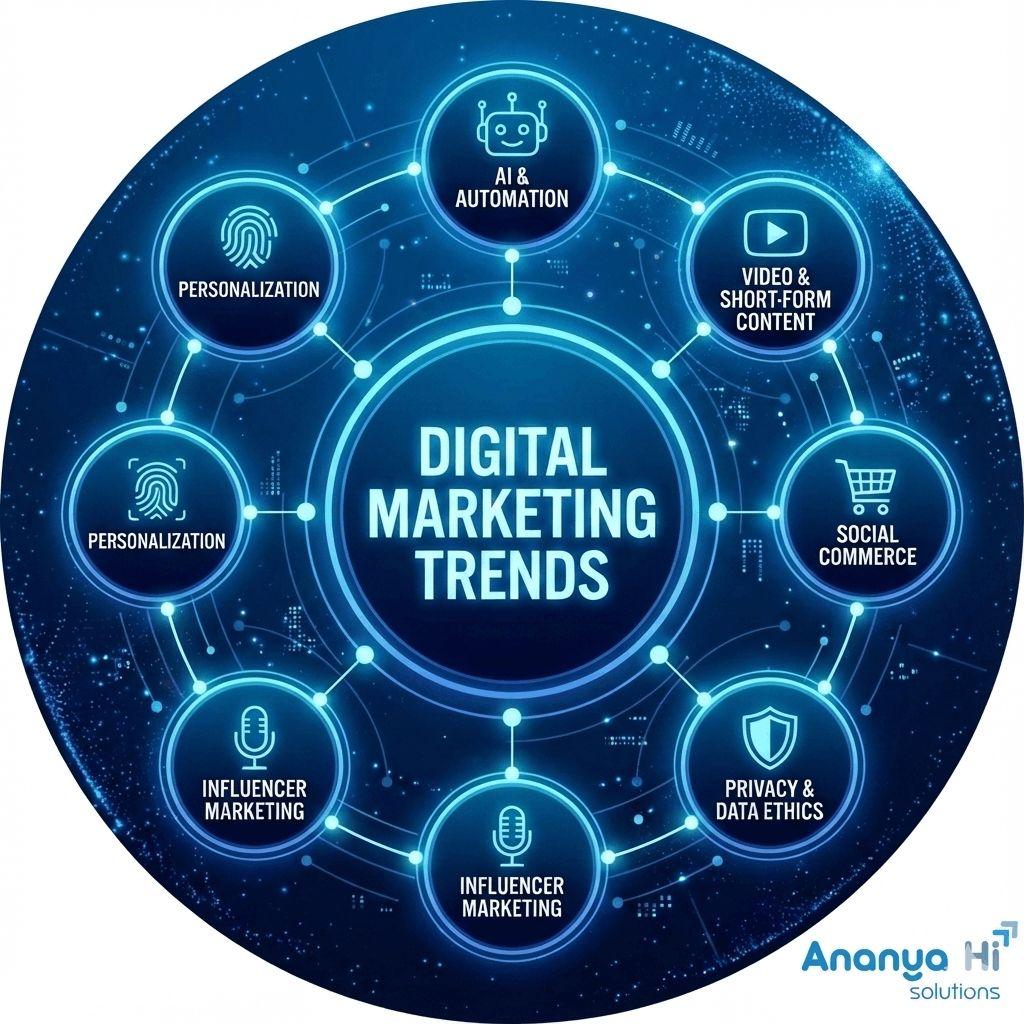
Why AI is Making a Big Impact on Digital Marketing
Transforming Marketing Strategy Through Intelligent Automation and Data-Driven Insights
Artificial Intelligence has emerged as the most transformative force in digital marketing, fundamentally changing how businesses connect with customers, optimize campaigns, and drive revenue growth. At Ananya Hi Solutions, we've witnessed firsthand how AI-powered technologies are revolutionizing the marketing landscape, delivering unprecedented results for businesses across industries. The integration of AI into marketing strategies isn't just a trend—it's becoming essential for companies that want to remain competitive in an increasingly digital marketplace.
The digital marketing industry is experiencing a paradigm shift as AI technologies mature and become more accessible to businesses of all sizes. What once required massive technology investments and specialized data science teams is now available through user-friendly platforms and integrated marketing tools. This democratization of AI technology means that small and medium-sized businesses can now compete with larger enterprises on a more level playing field, leveraging the same intelligent algorithms and predictive capabilities.
Hyper-Personalization at Unprecedented Scale
One of AI's most significant contributions to digital marketing is its ability to deliver personalized experiences to millions of customers simultaneously. Traditional marketing approaches relied on broad segmentation, grouping customers into large categories based on limited data points. AI changes this paradigm entirely by analyzing thousands of data points for each individual customer, including browsing behavior, purchase history, social media activity, device usage patterns, and real-time interactions.
Machine learning algorithms process this vast amount of data to create detailed customer profiles and predict preferences with remarkable accuracy. The result is hyper-targeted content that resonates with each individual's unique needs and interests. Businesses implementing AI-driven personalization report conversion rate increases of 25-40%, with some industries seeing even higher improvements. Email campaigns powered by AI achieve open rates 50% higher than traditional approaches, while personalized product recommendations can account for up to 35% of total revenue for e-commerce platforms.
The sophistication of AI personalization extends beyond simple product recommendations. Modern AI systems understand context, timing, and customer lifecycle stages. They recognize when a customer is in research mode versus ready-to-buy mode, adjusting messaging accordingly. They identify which communication channels each customer prefers and optimize delivery timing based on when individuals are most likely to engage. This level of personalization creates customer experiences that feel genuinely tailored rather than algorithmically generated, building stronger emotional connections between brands and consumers.
Predictive Analytics: Forecasting Success Before Launch
AI's predictive capabilities represent a quantum leap forward in marketing strategy development. Machine learning models analyze historical campaign data, market trends, competitor activities, and consumer behavior patterns to forecast outcomes with impressive precision. This predictive power allows marketers to identify which strategies will succeed, which channels will deliver the best ROI, and which customer segments are most likely to convert—all before investing significant resources.
Predictive analytics helps businesses optimize their marketing spend by identifying high-value opportunities and eliminating wasteful spending on underperforming channels. Companies using AI-powered predictive analytics report 20-30% reductions in customer acquisition costs while simultaneously improving conversion rates. These systems can also predict customer churn, enabling proactive retention strategies that save valuable customer relationships before they're lost.
Beyond campaign performance, predictive analytics enables sophisticated customer lifetime value calculations. AI models can predict which new customers will become high-value, long-term clients and which are likely to make only single purchases. This intelligence allows businesses to tailor their acquisition strategies, investing more resources in attracting and nurturing high-potential customers while maintaining cost-effective approaches for lower-value segments. The result is a more efficient allocation of marketing resources that maximizes overall profitability.
Predictive analytics also powers inventory management and product development decisions. By analyzing search trends, social media conversations, and purchasing patterns, AI can forecast demand for products and identify emerging market opportunities before competitors recognize them. This forward-looking capability gives businesses crucial advantages in fast-moving markets where timing can determine success or failure.
Intelligent Automation: Efficiency Meets Effectiveness
AI-powered automation is transforming routine marketing tasks, freeing marketing teams to focus on strategy and creativity. Chatbots and virtual assistants now handle customer inquiries 24/7, providing instant responses that maintain quality while dramatically reducing response times. These AI assistants don't just answer simple questions—they can guide customers through complex purchase decisions, troubleshoot issues, and even upsell relevant products based on conversation context.
Modern AI chatbots use natural language processing to understand intent behind customer questions, even when phrased in unexpected ways. They learn from each interaction, continuously improving their ability to provide helpful responses. When situations arise that require human intervention, these systems intelligently route customers to appropriate team members, often providing context and conversation history to ensure seamless handoffs.
Beyond customer service, AI automates email marketing campaigns, social media posting, ad bidding, and content distribution. Smart automation systems adjust campaigns in real-time based on performance data, shifting budgets to high-performing ads and pausing underperforming ones without human intervention. This dynamic optimization ensures marketing budgets are always working at peak efficiency. Research shows that marketing teams using AI automation save 30-40% of their time on routine tasks, allowing them to invest more energy in strategic initiatives.
Programmatic advertising represents one of automation's most powerful applications. AI algorithms automatically purchase ad placements across millions of websites, apps, and platforms, targeting specific audiences with precision while optimizing bids in real-time. This automated approach to media buying achieves better results at lower costs than manual purchasing, with businesses reporting 30-50% improvements in advertising ROI.
Content Creation and Optimization
AI is revolutionizing content marketing by assisting in both creation and optimization. Natural language processing algorithms analyze top-performing content across the web to identify patterns in structure, tone, length, and topic coverage. These insights inform content strategies, helping marketers create material that's more likely to engage audiences and rank well in search results.
AI writing assistants can generate drafts for blog posts, social media updates, product descriptions, and ad copy, dramatically accelerating content production. While human creativity and oversight remain essential, these tools handle time-consuming first drafts and routine content needs. AI also optimizes existing content by suggesting improvements in headlines, meta descriptions, and keyword usage based on search intent analysis and competitive research.
Video and image content benefit from AI as well, with tools that automatically generate captions, optimize thumbnails, and even create short video clips from longer content. This multiformat approach helps businesses maintain consistent presence across all digital channels without proportionally increasing their content production resources.
Content optimization extends to search engine optimization, where AI tools analyze ranking factors, competitor strategies, and search algorithm updates to recommend improvements. These systems can identify content gaps in a website's coverage, suggest internal linking opportunities, and even predict which topics are likely to generate traffic and engagement. The combination of AI-powered content creation and optimization enables businesses to execute comprehensive content strategies that would require significantly larger teams using traditional methods.
Advanced Customer Segmentation and Targeting
Traditional demographic segmentation divides audiences into broad categories like age groups or geographic regions. AI takes segmentation to entirely new dimensions by identifying micro-segments based on behavioral patterns, psychographic characteristics, and predictive lifetime value. These sophisticated segments enable precision targeting that was previously impossible.
AI algorithms continuously refine these segments as they gather more data, ensuring targeting strategies evolve with changing customer behaviors. This dynamic segmentation allows businesses to reach the right person with the right message at the right time through the right channel—the holy grail of marketing effectiveness. Companies implementing AI-powered segmentation see 15-25% improvements in campaign performance and significant increases in customer lifetime value.
Lookalike modeling represents another powerful segmentation capability. AI analyzes the characteristics of a business's best customers and identifies similar individuals in broader audiences who haven't yet engaged with the brand. This technique dramatically expands addressable markets while maintaining targeting precision, allowing businesses to find new customers who are highly likely to convert.
Cross-channel segmentation ensures consistent messaging as customers move between touchpoints. AI tracks individual customer journeys across websites, mobile apps, email, social media, and even physical stores, creating unified profiles that inform personalized experiences regardless of where interactions occur. This omnichannel approach prevents the disjointed experiences that frustrate customers when businesses fail to recognize them across different platforms.
Real-Time Decision Making and Optimization
Perhaps AI's most powerful capability is its ability to make and execute decisions in real-time based on live data. AI systems monitor campaign performance across all channels simultaneously, identifying opportunities and problems as they emerge. When an ad underperforms, AI can automatically adjust targeting parameters, creative elements, or bidding strategies within seconds.
This real-time responsiveness extends to website personalization, where AI dynamically adjusts page layouts, product recommendations, and call-to-action buttons based on individual visitor behavior. A first-time visitor might see educational content and brand-building messages, while a returning customer sees personalized product recommendations based on their browsing history. These instant optimizations improve user experience and drive measurable increases in conversion rates.
Real-time optimization also powers dynamic pricing strategies. AI algorithms adjust prices based on demand patterns, competitor pricing, inventory levels, and individual customer value, maximizing revenue while maintaining competitiveness. This approach has become standard in industries like travel and e-commerce, where prices can fluctuate multiple times per day in response to market conditions.
Enhanced Customer Insights and Analytics
AI transforms raw data into actionable insights with unprecedented speed and accuracy. Traditional analytics tools require manual analysis and interpretation, creating delays between data collection and decision-making. AI analytics platforms automatically identify trends, anomalies, and opportunities, presenting findings in clear, actionable formats.
Sentiment analysis tools use AI to monitor social media, review sites, and customer feedback channels, gauging public perception of brands, products, and campaigns. These systems can detect shifts in sentiment before they become major issues, enabling proactive reputation management. They also identify brand advocates and influencers who can amplify marketing messages organically.
Customer journey analytics powered by AI map the complex, non-linear paths customers take from awareness to purchase. These insights reveal which touchpoints have the greatest influence on conversion, where customers commonly drop off, and which content moves them forward in their decision-making process. Armed with this intelligence, marketers can optimize their strategies to address friction points and reinforce successful elements.
Attribution modeling has become significantly more sophisticated with AI. Multi-touch attribution models use machine learning to assign appropriate credit to each marketing touchpoint that contributes to a conversion, moving beyond simplistic first-touch or last-touch models. This accurate attribution helps businesses understand which marketing activities truly drive results, informing smarter budget allocation decisions.
Voice Search and Conversational Marketing
The rise of voice-activated devices and voice search has created new marketing channels that rely heavily on AI. Natural language processing enables devices to understand spoken queries and provide relevant responses. Marketers must now optimize content for conversational search patterns, which differ significantly from traditional text searches.
Voice commerce is emerging as a significant opportunity, with AI-powered assistants enabling customers to research products, compare options, and make purchases using voice commands. Businesses that optimize for voice search and commerce position themselves to capture this growing market segment, which is particularly strong among younger consumers and tech-savvy demographics.
The Competitive Advantage and Future Outlook
The impact of AI on digital marketing is clear and quantifiable. Businesses embracing AI technologies report 50-60% higher engagement rates, 25-35% improvements in conversion rates, and 20-40% reductions in customer acquisition costs. Beyond these metrics, AI provides strategic advantages that are harder to quantify but equally valuable: deeper customer understanding, faster adaptation to market changes, and the ability to scale personalized experiences without proportionally scaling resources.
As AI technology continues to evolve, we're seeing emerging capabilities that will further transform digital marketing. Computer vision enables visual search and image-based recommendations. Emotion AI can detect customer emotional states through text, voice, or facial expressions, enabling even more nuanced personalization. Generative AI creates original content, designs, and creative assets at scale.
The businesses that will thrive in the coming years are those that embrace AI not as a replacement for human creativity and strategy, but as a powerful amplifier of human capabilities. At Ananya Hi Solutions, we help businesses navigate this transformation, implementing AI technologies that align with their goals and capabilities. The future of marketing is intelligent, automated, and deeply personalized—and that future is already here. Companies that delay AI adoption risk falling behind competitors who are already leveraging these powerful capabilities to deliver superior customer experiences and achieve better business results.